

What is it?
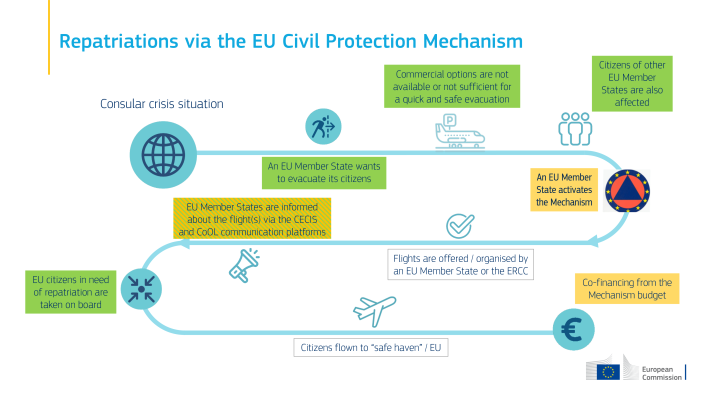
The EU Civil Protection Mechanism can be activated by EU Member States and 10 participating states to request assistance for consular support to their citizens, for example, in the context of evacuation operations.
Previous operations include repatriations during the COVID-19 pandemic (2020 and 2021), and evacuations from Afghanistan (2021). In 2023, the EU Civil Protection Mechanism supported the evacuations of EU citizens from Niger, Sudan, Israel and Gaza.
Why is this important?
In emergencies, repatriation flights coordinated under the EU Civil Protection Mechanism ensure the safe return of EU citizens of different nationalities.
EU citizens can seek help from any other EU Member State’s embassy if they require assistance. An EU citizen is “unrepresented” if their own Member State has no embassy or consulate in a third country or can’t provide consular protection. Emergency relief and repatriation can be provided in that case.
When activated by an EU Member State or a participating state, the EU Civil Protection Mechanism goes beyond this right. It offers support to all affected EU citizens who want to be evacuated, irrespective of their nationalities.
EU solidarity during evacuation and repatriation effort is key. Since these operations are often time sensitive, EU Member States need to coordinate and share available resources.
The Emergency Response Coordination Centre (ERCC) is at the centre of the EU Civil Protection Mechanism operations. It provides a platform to facilitate the coordination of evacuation and repatriation efforts.
The ERCC operates a 24/7 duty system, able to respond to disasters around the world 24 hours a day. It works in close coordination with the European External Action Service (EEAS).
How are we helping?
If assistance is requested by any EU Member State or participating state in the EU Civil Protection Mechanism (Albania, Bosnia and Herzegovina, Iceland, Moldova, Montenegro, North Macedonia, Norway, Ukraine, Serbia, and Türkiye), the European Commission can support a consular response.
The assistance can take the form of:
- evacuation resources (planes, helicopters, boats, vessels etc.)
- emergency response capacities (search and rescue teams, advanced medical posts, medical evacuation, water purification assets, technical assistance and support teams, etc.)
- in-kind assistance (emergency shelters, tents, blankets, sleeping bags, electric heaters, power generators, hygiene kits, medicine kits, communication equipment, etc.)
These resources are offered and deployed by EU Member States and participating states on a voluntary basis. The aim is to help EU citizens facing serious difficulties abroad during a crisis or a disaster.
The European Commission facilitates the deployment of this assistance, coordinates the European response, and co-finances transport costs.
Repatriation operations in the context of COVID-19
Following the outbreak of the COVID-19 pandemic, EU Member States turned to the EU Civil Protection Mechanism to an unprecedented scale for urgent assistance in bringing their nationals home.
As a result, the EU Civil Protection Mechanism played a key role in the successful worldwide repatriation effort during the pandemic’s initial months.
Nearly 100,000 out of the 600,000 EU citizens who were repatriated during COVID-19 did so with the help of the EU Civil Protection Mechanism.
In total, the EU Civil Protection Mechanism facilitated and co-financed over 400 repatriation flights. This was made possible by an unparalleled coordination effort facilitated by the ERCC and the European External Action Service.
Last updated: 10/06/2024