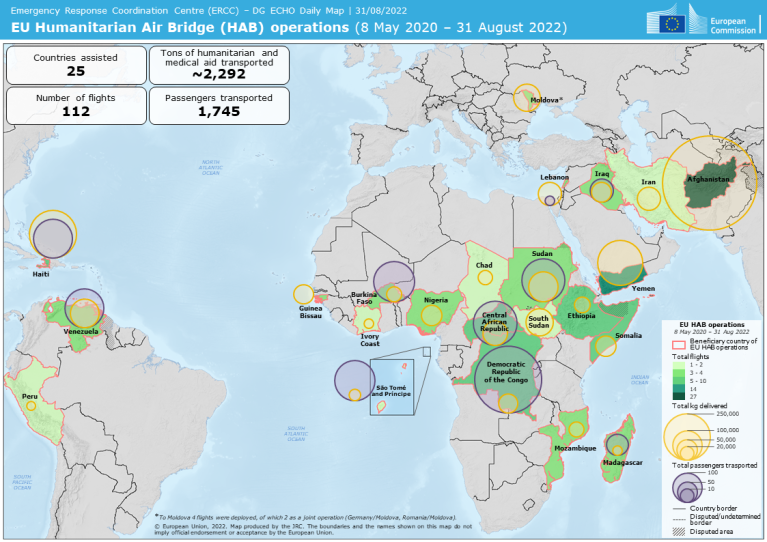

What is it?
The EU Humanitarian Air Bridge flight operations are intended to help reinforce humanitarian or emergency responses in countries facing fragile contexts.
These flights help fill critical gaps by facilitating the delivery of humanitarian aid, emergency assistance, and the transport of humanitarian staff when required. The initiative was initially set up in response to the transport constraints imposed by the COVID-19 pandemic.
The EU Humanitarian Air Bridge is an ad hoc initiative operated on a needs-based approach. Its implementation brings together several actors: the European Commission, EU Member States, national authorities of the destination countries, and humanitarian and civil society organisations.
Why is this important?
The COVID-19 pandemic brought about huge logistical challenges for the humanitarian community, including the absence of commercial flights due to transport restrictions.
Against this background, the Commission set up the EU Humanitarian Air Bridge. As part of the EU’s global coronavirus response, it includes the transport of aid to some most fragile countries.
The Humanitarian Air Bridge ensures the continuation of humanitarian assistance and the delivery of essential medical supplies. These supplies included material needed to support countries’ COVID-19 response.

The initiative also helped with the transport of humanitarian teams on rotation and assisted in passenger repatriation flights organised by Member States.
In the current context, the EU Humanitarian Air Bridge flights are helping address various constraints faced by humanitarian actors on the ground. This includes situations where supplies by far outstrip needs and humanitarian access is limited or hampered by logistical or administrative barriers.
How are we helping?
The EU Humanitarian Air Bridge is at the service of humanitarian actors. The decision to deploy these flights is driven by needs on the ground.
Flights are coordinated with Member States and aid partners, identifying the most critical gaps. They take place in cooperation with the receiving countries.

The European Commission finances 100% of the transport costs. The users of the EU Humanitarian Air Bridge operations provide the cargo and supplies transported on board.
The EU Humanitarian Air Bridge complements other humanitarian air services that the EU has in place or that it supports to help the humanitarian community continue the effective delivery of assistance.
Start of the operations
The EU Humanitarian Air Bridge operations were launched on 8 May 2020, with the first flight to the Central African Republic. Since then, more than 80 flights have reached critical areas in Africa, Asia, and the Americas.
The EU has coordinated and financed the delivery of over 1,570 tonnes of material, consisting of humanitarian and/or medical aid.
In 2020, we carried out flights to Afghanistan, the African Union, Burkina Faso, Central African Republic, Chad, Côte d’Ivoire, the Democratic Republic of the Congo, Guinea Bissau, Haiti, Iran, Iraq, Lebanon, Nigeria, Peru, São Tomé and Príncipe, Somalia, South Sudan, Sudan, Venezuela, and Yemen.
2021
Building on the operations conducted in 2020, the EU Humanitarian Air Bridge resumed in June 2021, with over 20 flights to Afghanistan, Ethiopia, Haiti and Mozambique. They helped deliver much-needed humanitarian aid.
Since August 2021, 35 Humanitarian Air Bridge flights have been operated to Afghanistan. They helped ensure a continuous inflow of vital medicines and medical items for Afghanis in need and alleviate the humanitarian crisis in the country.
2022
In 2022, the EU Humanitarian Air Bridge continues to provide emergency assistance to people in need. Over 40 flights took place around the world during the year.
EU Humanitarian Air Bridge operations to Madagascar assured the timely departure and arrival of EU emergency experts from France, Finland and Sweden, and EU staff. They helped authorities deal with the repercussions of the tropical storms and cyclones that hit the island in February.
In July 2022, a Humanitarian Air Bridge was launched for Somalia, aiming at delivering lifesaving supplies to hard-to-reach areas, no longer accessible by road. The operation ended in December 2022.
Between July and December 2022, the EU operated 38 Humanitarian Air Bridge flights in Somalia, delivering more than 243 tonnes of nutritional, medical and other supplies to hard-to-reach areas.
In November 2022, a Humanitarian Air Bridge was launched for Burkina Faso. It delivered food and essential supplies to hundreds of thousands of people at risk of starvation in localities under blockade.
2023-2024
Palestine
In response to the rapid worsening of the humanitarian situation of Palestinians in Gaza, due to intensification of hostilities between Hamas and Israel, the EU set up a Humanitarian Air Bridge operation. This operation carries humanitarian cargo provided by partners and EU Member States.
As of October 2024, a total of 60 flights transported over 2,700 tonnes of humanitarian cargo supplied by humanitarian partners, EU-owned stockpile items, and donations from Member States.
Assistance includes health items, pharmaceuticals, water and sanitation items.
Most of the cargo sent through the EU Humanitarian Air Bridge has already reached Gaza by truck.

Lebanon
Following the large-scale military operation launched by Israel in Lebanon, the EU launched a Humanitarian Air Bridge operation to Beirut on 9 October 2024. As of 18 October, 3 flights from Italy and Dubai transported 105 tonnes of EU-owned stock including hygiene items, blankets and emergency shelter kits, donated to humanitarian partners, into the country.
Flights are scheduled upon demand of partners.
Syria
In February 2023, the EU set up a Humanitarian Air Bridge for Syria to provide further support for the Syrian people impacted by the earthquake.
The first 2 planes with emergency aid landed in Damascus on 26 February 2023, delivering much-needed relief items such as winterised tents, shelter equipment and heaters.
The flights transported assistance from the EU's own humanitarian stockpiles in Brindisi and Dubai to the Syrian people in both government controlled and non-government controlled areas, via the mobilisation of the European Humanitarian Response Capacity.
Overall, the EU humanitarian air bridge for Syria delivered 420 tonnes of assistance.
Democratic Republic of the Congo (DRC)
In March 2023, given the rapidly deteriorating situation in the east of the Democratic Republic of the Congo, the EU set up a Humanitarian Air Bridge operation to Goma.
Supported by France, a total of 15 flights delivered 474 tonnes of medical and nutritional supplies to DRC, among other goods.
Sudan
Following the outbreak of the conflict in Sudan in April 2023, the EU launched a Humanitarian Air Bridge for a total of 8 flights between Dubai and Port Sudan to support its humanitarian partners in providing an effective humanitarian response.
The EU also launched a Humanitarian Air Bridge between Europe and Chad. Since May 2023, 10 flights arrived in N’Djamena. In total, 912 tonnes of humanitarian supplies were delivered through Humanitarian Air Bridge operations to both Chad and Sudan.
Last updated: 18/10/2024
Facts & figures
2020: 54 flights to 20 countries in Africa, Asia and the Americas (and 9 return flights to Europe) delivering 1,140 tonnes of vital medical and humanitarian equipment. More than 1,500 medical and humanitarian staff and other passengers transported.
2021: 19 flights delivering 485 tonnes of humanitarian aid to Afghanistan, Ethiopia, Haiti and Mozambique.
2022: 54 flights delivering 847 tonnes of humanitarian aid to Afghanistan, Somalia, and Burkina Faso, and 3 passengers flights to Madagascar (84 passengers)
2023: 84 flights delivering 3,838 tonnes of humanitarian aid to Afghanistan, Armenia, Chad, DRC, Nepal, Niger, Palestine, Sudan and Syria.
2024: 74 flights delivering more than 2,700 tonnes of humanitarian aid to Afghanistan, Chad, Haiti, Lebanon, Niger, Palestine and Yemen. (until 18/10/2024)