
Introduction
Burkina Faso's complex and volatile crisis continues to deteriorate quickly and severely.
The internal conflict has intensified, spreading across all regions of the country. Armed violence is increasingly targeting civilians and has caused massive population displacements. Burkina Faso is now ranking first in the Global Terrorism Index, accounting for nearly a quarter of all terrorist deaths globally.
In addition, the country is suffering an unprecedented food crisis and significant deterioration in access to water and essential social services (health, education).
Difficult access to populations in need of humanitarian assistance is a major concern, especially in the areas which are not controlled by the State, now estimated as representing 1/3 of the territory.
What are the needs?
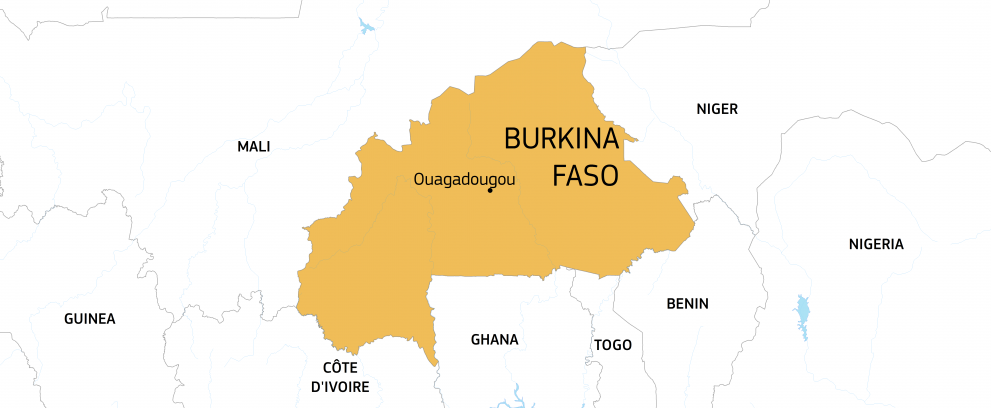
Conflict affects most of the regions in Burkina Faso, especially in bordering areas in the North and East of the country and intensifies in western and southern regions, notably at the border with Niger, Togo and Cote d’Ivoire. Provisional figures for 2024 already document more than 6,100 fatalities (ACLED, 20/09/2024), with a large share of civilians.
Estimates for 2024 identify 6.3 million people in need of humanitarian assistance, 27% out of the total Burkinabè population.
The protracted conflict has thoroughly deteriorated the country’s food security situation.
According to the March 2024 Cadre Harmonise, more than 2,7 million people will be experiencing crisis levels of acute food insecurity (IPC Phase 3 or higher) and need immediate assistance.
Over 2 million people, 10% of Burkinabè, are internally displaced due to violence according to official figures dating March 2023. Indications from the field show the situation keeps deteriorating at a worrying pace.
The widespread violence affects people’s basic needs and income opportunities in large parts of the country. Access to fields and markets is challenging, and families cannot always meet their needs. The authorities impose restrictive measures in the context of the ongoing conflict. These may limit the movement of populations, impacting their daily life (through, for example, a ban on motorbikes in some communes or establishing military zones where people are requested to leave). The humanitarian response is also severely restrained due to the nation-wide ban on assistance using cash transfers.
These restrictive measures hinder humanitarian access to those in need. Challenges include conflict dynamics, actions by non-state armed groups (use of explosive devices, irregular checkpoints, attacks on vital infrastructure etc.), and authorities’ imposed restrictions (armed escorts). Armed convoys, used as a last resort, may cause potentially more harm, dramatically undermining the delivery of assistance to an estimated 1 million people in the 39 locations under blockade.
The conflict severely impacts educational and health facilities. In May 2024, OCHA reported that over 5,700 schools were closed due to insecurity, depriving more than 800,000 children of education. According to the health cluster (July 2024), 426 health facilities are closed due to insecurity, depriving more than 4 million people of access to health care. Epidemics occur regularly.
How are we helping?
In 2024, the EU has allocated €45 million for humanitarian aid in the country.
These funds support actions on (i) food insecurity and malnutrition, (ii) protection, (iii) health, (iv) nutrition, (v) shelter, (vi) water, sanitation and hygiene, (vii) education, (viii) disaster preparedness activities, and (ix) a rapid response to displacements.
EU humanitarian aid focuses on supporting vulnerable internally displaced people and host populations affected by the ongoing armed conflict. In the context of fast-growing crises, particular attention is paid to rapid response to the basic needs of newly displaced individuals and people living in localities under blockade.
Supporting the operations to enable partners to operate in a complex environment is also key in this context, the EU notably supports humanitarian air operations. Together with the United Nations Humanitarian Air Service (UNHAS), the EU has been providing last-mile access to remote regions and areas under blockade which can be reached exclusively by air. Since 2022, we have been operating a EU-funded EU Humanitarian Air Flight (EU HAF) helicopter at the service of the entire humanitarian community and EU partners, carrying up to 800 passengers per month, in addition to cargo,
We also contribute to build the capacity of local organisations to prepare for, and respond to, emergencies.
Uprooted Burkinabe people and host communities receive food assistance, shelter, and essential items. Our priority is also to improve access to health care and mental health support to help people overcome trauma or other protection issues due to conflict.
EU support provides education in an environment where schools have been closed and teachers and students face threats from armed groups. In 2023, 14% of all children in 4 identified regions have benefitted from Education in Emergencies assistance. Protection is mainstreamed in all funded actions.
EU humanitarian aid funds the delivery of emergency food assistance to the most vulnerable in the most affected areas and to the most vulnerable in the areas under blockade during the lean season – the crucial period of the year between harvests, normally running from June to September, when food reserves are depleted. At the same time, the assistance provides free nutritional care for malnourished children under-5 years old.
We are also supporting actions on disaster risk reduction. Ongoing programmes include increasing communities’ preparedness to face health risks and strengthening the national response system to prevent and manage food and nutrition crises.
We also support preparedness activities undertaken by the International Federation of Red Cross and Red Crescent Societies (IFRC) in response to epidemics and other hazards.
To reinforce people's ability to cope with crises, the EU links its humanitarian emergency assistance with its longer-term development cooperation.
Last updated: 20/09/2024
Facts & figures
More than 2.7 million people estimated to need emergency food assistance during the 2024 lean season (Cadre Harmonisé, March 2024)
More than 2 million internally displaced people (CONASUR, March 2023)
Hosting over 40,000 refugees, mainly from Mali (UNHCR, August 2024)
EU humanitarian funding:
€45 million allocated in 2024
€44 million in 2023
€285.45 million since 2014