What is it?
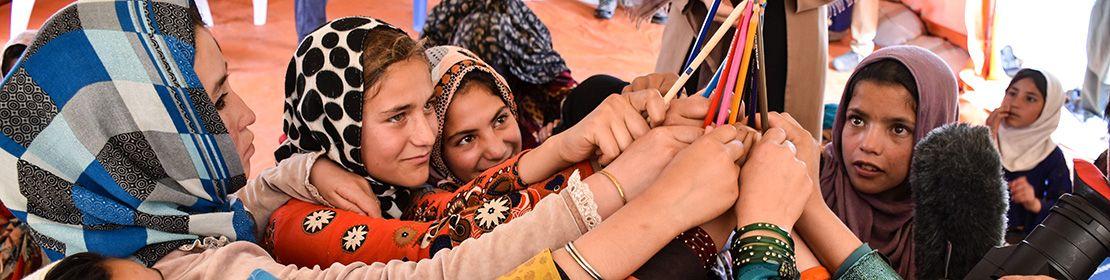
Children’s right to quality education does not stop in times of humanitarian emergencies. With its policy on education in emergencies and protracted crises, the EU aims to minimise the impact of crises on children’s learning.
The EU helps children caught in crises go back to and stay in education through various formal and non-formal education pathways. We also support teachers with training, coaching, and skills development actions.
The EU is also increasingly focusing on protecting education from attack and the rollout of the Safe Schools Declaration.
We have committed to placing an emphasis on a whole-child approach, addressing needs in a holistic manner, combining the delivery of education with mental health and psychosocial support, together with protection, water and sanitation initiatives, healthcare, and disaster preparedness.
Over 65% of EU-funded actions on education in emergencies have integrated protection elements. This ensures safe learning spaces and links, where needed, to specialised child protection services, interventions to prevent and respond to school-related gender-based violence, and support to address stress and trauma, ensuring psychosocial well-being.
Why is this important?
Education is a fundamental right and a basic need for children caught up in humanitarian crises. It is crucial to give them a better future, allow them to develop their full potential, and equip them with skills they can use in the future. Protection will restore their sense of normality and safety.
As a result, children will become more self-sufficient and have a stronger voice on issues affecting them.
Education is also one of the best ways of investing in peace, stability, and economic growth. Yet it is also one of the most underfunded areas of humanitarian aid: only around 3% of global humanitarian funding is allocated to education.
Despite the sustainable development goal of ensuring quality education for every child, there are still 244 million children who do not go to primary or secondary school. Among refugee children, only 77% have been enrolled in primary and 31% in secondary school.
Each year, around 12 million girls are married before the age of 18 – including 38% of girls in sub-Saharan Africa. More than 150 million children aged five 5 to 17 are victims of forced labour.

During armed conflict or insecurity, education comes under attack. In over 11,000 attacks during the past 5 years, more than 22,000 students, teachers, and academics have been injured, killed, or harmed (data from the Global Coalition to Protect Education from Attack).
More than 3,000 attacks on education were identified in 2022, a 17% increase over the previous year. Almost one-third of all attacks took place in just 3 countries: Ukraine, Myanmar, and Burkina Faso.
According to the UN, since October 2023, more than 625,000 students and 22,564 teachers in the Gaza Strip have been affected by school closures and attacks on education with no access to education and a safe place.
How are we helping?
Policy
The EU is one of the top donors to and policy shapers of education globally. By making education in emergencies part of its humanitarian response – linked closely with development cooperation – the EU makes full use of its humanitarian and development funding instruments to support children affected by crises.
The following priorities help the EU support the continuity of quality and safe education during crises:
- partnerships for a rapid, efficient, effective, and innovative education response
- promoting access, inclusion, and equity
- championing education for peace and protection
- supporting quality education for better learning outcomes.
They are set out in the European Commission’s Communication on Education in Emergencies in Protracted Crises of May 2018, endorsed by EU countries in Council Conclusions in November 2018.
In March 2019, the Commission published its guidance document on Education in Emergencies in EU-funded Humanitarian Aid Operations.

Funding
The EU spent over €1 billion on education in emergencies between 2015 and 2023.
For 2024, the EU has set aside €157 million to support learning for children and youth caught in humanitarian emergencies.
The share of funding allocated to education in emergencies in our humanitarian budget has substantially increased over the last few years (starting from 1% in 2015). It has been maintained at 10% of the initial humanitarian budget since 2019.
Over 21 million girls and boys affected by crises in 63 different countries worldwide benefited from EU-funded educational projects between 2015 and 2023.
EU humanitarian funding is delivered through its humanitarian partners, notably NGOs, United Nations agencies, and international organisations.
Actions
The EU supports a variety of actions under the education in emergencies policy, with over half of them promoting education for girls.
EU humanitarian aid supports children and teachers in both formal and non-formal education. This includes accelerated education programmes that condense several years of the curriculum to help children reach the grade corresponding to their age faster.
Our projects focus on children living in host communities (65%), internally displaced children (55%), and refugee children (50%).
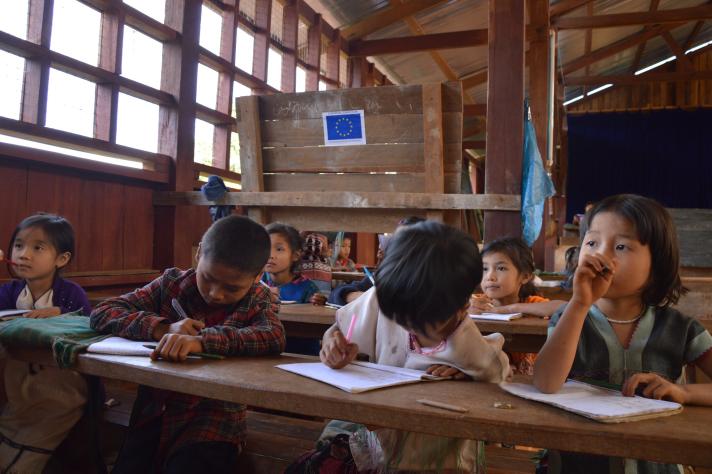
Examples of EU-supported actions are:
- formal and non-formal learning activities;
- providing teaching and learning materials;
- training and mentoring teachers and other education workers;
- psychosocial support and life skills training (including health and hygiene awareness, mine risk education, conflict and disaster risk reduction activities, and personal resilience and recreation sessions);
- community sensitisation and awareness-raising;
- school infrastructure rehabilitation and improvement.
EU-funded actions also support (i) parent-teacher associations, (ii) community-based school management, (iii) student/children clubs, and (iv) peer-to-peer training and activities.
About 1/5 of all actions include innovative solutions for students and teachers.
Last updated: 23/01/2024
Facts & figures
Crises and humanitarian emergencies affect children’s access to quality education.
The EU allocated over €1 billion for education in emergencies between 2015 and 2023.
Related information
- #EducationNoMatterWhat campaign
- Video "Helping crisis-affected children access school"
- Video "Supporting access to education in humanitarian crises"
- Commission Communication on Education in Emergencies and Protracted Crises
- Commission Staff Working Document on Education in Emergencies in EU-funded Humanitarian Aid Operations
- Education in Emergencies Project Mapping Report