European Commission logo
European Civil Protection and Humanitarian Aid Operations
A large group of men, women, and children sit tightly packed on top of a white lorry piled high with colourful bags and bundles, their bare feet dangling over the edge as they travel in the open under a clear blue sky.
© European Union, 2026 (photographer: Peter Biro)
Humanitarian aid

What is humanitarian aid?

Humanitarian aid is material and logistic assistance, to people in need. It generally refers to the provision of immediate, short-term relief in crisis situations, such as food, nutrition, shelter and healthcare.

As laid out in International humanitarian law, humanitarian aid is channelled impartially to the affected populations, regardless of their race, ethnic group, religion, gender, age, nationality or political affiliation. 

The overriding objectives of humanitarian action, as enshrined in the European consensus on humanitarian aid, are:

  • preserving life
  • preventing and alleviating suffering
  • helping to maintain human dignity in the face of natural hazards and human-induced disasters

Facts and figures

Through its humanitarian efforts, the EU provides vital support to those most in need.

  • Icon representing food assistance, showing a bottle next to an ear of maize.
    over 240 million people

    in need of humanitarian assistance in 2026

    (United Nations)

  • people, the globe, hand
    at least 117.8 million people

    forcibly displaced in 2025

    (UNHCR)

  • people, the globe, hand
    1 in every 5 children

    affected by war

The European Union provides needs-based humanitarian assistance to the people hit by human-induced disasters and natural hazards with particular attention to the most vulnerable victims and based on humanitarian principles.

  • An open hand holding the silhouettes of three people, set against a partial globe in the background, symbolising protection and support for refugees and internally displaced persons worldwide.
    over 30 years

    of humanitarian assistance provided by the EU, since 1992

  • A globe icon in blue, representing global reach or worldwide context.
    +110 countries

    reaching millions of people in need across the world

  • A globe icon in blue, representing global reach or worldwide context.
    +40 countries

    the EU has a field network of over 400 experts and offices in more than 40 countries

Humanitarian funding

€1.9 billion for 2026

As humanitarian needs continue to rise globally, the EU maintains its commitment to support those in need by adopting its initial annual humanitarian budget of €1.9 billion for 2026.

The EU remains a global leading donor

Between 2018 and 2024, EU humanitarian funding has been continuously grew continuously. Notably, in 2022, the EU’s final humanitarian budget saw a 20% rise, up to €2.62 billion, €440 million more than the year before.

Why does humanitarian aid matter?

Humanitarian aid is a core part of the EU’s external action and an expression of solidarity with people in crisis. Helping the most vulnerable, those in need and those affected by human-induced or natural disasters.

Needs are growing fast. In 2026, more than 240 million people are expected to need humanitarian assistance, and around 120 million people are forcibly displaced. The conflicts in the Middle East, Ukraine and Sudan, as well as climate-related disasters, put the international humanitarian system under severe pressure.

EU humanitarian aid covers intervention areas such as: 

The funding for humanitarian aid operations is intended for countries outside the EU. In exceptional cases the EU can also fund emergency support within the EU when disasters are on an exceptional scale.

The European Commission has been providing humanitarian aid since 1992 in over 110 countries, reaching millions of people across the globe each year. As climate change will only increase the frequency of wildfires, droughts, floods and hurricanes the EU and its Member States also provide support to strengthen capacities to respond to climate-related disasters.

How is humanitarian aid delivered?

The European civil protection and humanitarian aid operations department coordinates EU humanitarian assistance. 

The humanitarian assistance funded by the EU is delivered in partnerships with:

  • UN agencies (such as OCHA, WFP, UNFPA, WHO, UNHCR and UNICEF)
  • international organisations (such as IFRC and ICRC)
  • NGOs

A large network of more than 400 EU humanitarian experts, based in over 40 countries, monitors crises and EU-funded operations on the ground. 

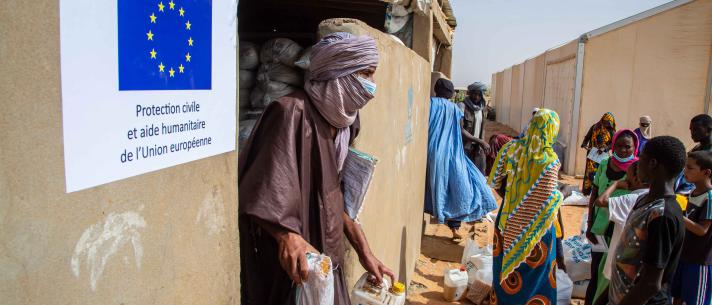
Partner organisations must submit project proposals, follow strict rules for assessing and monitoring their work, and clearly acknowledge EU support, including by displaying the EU visual identity where projects take place. 

Addressing global humanitarian challenges

The international humanitarian system is under severe pressure, with the number of crises and their duration growing, while funding cuts and insecurity are making life-saving aid increasingly difficult to deliver.  

Reforming EU humanitarian aid to meet today’s global challenges, the new approach on humanitarian aid, presented in May 2026, sets out concrete solutions to ensure humanitarian aid reaches people in need across the globe.

The EU will protect, perform and partner and continue to provide needs-based, inclusive and non-discriminatory assistance to save lives and preserve human dignity.

How does the EU take action?

Main thematic policies

The EU adapts its humanitarian action to evolving global challenges and promotes key thematic policies:

Other sectors and priorities

The EU adapts its humanitarian action to evolving global challenges and develops various sectors and priorities: