
Introduction
Since 2011, Libya has faced intense conflict and political fragmentation that have greatly impacted Libya’s social fabric, basic services, and national infrastructure.
The economy, already damaged by conflict and COVID-19, has been furtherly affected by Russia’s war in Ukraine and the effects of climate change. This has made it even more difficult for the most vulnerable Libyans, refugees and migrants.
In the aftermath of the devastating floods in September, the EU is mobilising emergency assistance via its Civil Protection Mechanism.
What are the needs?
According to the 2023 Global Humanitarian Overview, as of January 2023, the overall number of people in need decreased by 59% compared to previous years. It is estimated that over 328,000 people require some form of humanitarian assistance.
The number of internally displaced people continues to decline. However, mine contamination and a lack of safety, jobs and services deter people from returning home.
Libya hosts approximately 706,000 migrants from 44 countries, thousands of which endure extreme living conditions in urban settings and even more so in detention centres. The protection challenges they face are linked to their fragile status in country, which limits their access to essential services.
Furthermore, they are exposed to higher risks of violence, exploitation, arbitrary detention, hazardous living conditions, and abuse at the hands of smugglers and traffickers.
Recent floods
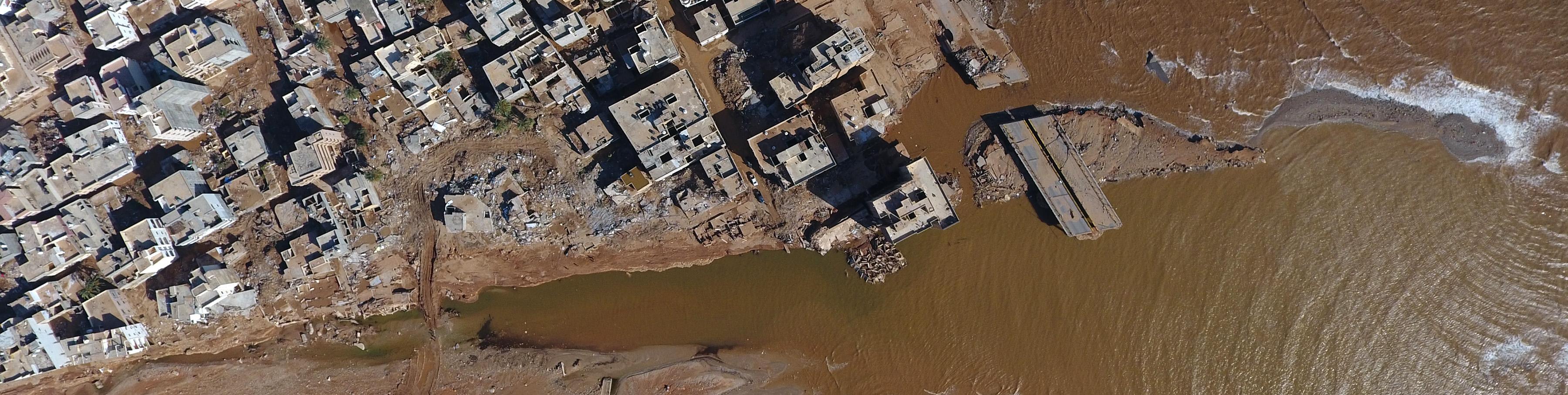
The impact of Storm Daniel, which hit northeastern Libya in September 2023 and its catastrophic aftermath is expected to have dramatically changed the humanitarian landscape.

The torrential rainfall of storm Daniel generated massive floods. It has also caused the breach of 2 dams located in the south of Derna, leading to the destruction of entire neighbourhoods and thousands of casualties.
As of 14 September 2023, around 35,000 people are estimated to have been displaced due to the storm, while the death toll stands at a whopping 5,000 people.
Figures of people in need and internally displaced will be adjusted when official and reliable assessments will be available.

How are we helping?
Since 2011, the EU has allocated over €94.5 million in humanitarian aid to Libya. This amount includes the emergency allocation of €5.7 million in humanitarian funding to tackle the most urgent needs of the people affected by the impact of Storm Daniel in September 2023.
This funding is channeled through humanitarian partners operating on the ground to deliver lifesaving health and water and sanitation supplies to the most vulnerable people hit by the floods.
The EU’s humanitarian funding to tackle disaster needs is complemented by substantial civil protection assistance.
The civil protection assistance is offered by EU Member States and coordinated via the EU Civil Protection Mechanism. It includes medical teams and equipment, shelter and food items, generators, and rescue vehicles among other.

EU-funded humanitarian aid in Libya is indiscriminately given to vulnerable people, based on needs and regardless of their nationality or status.
Libya also receives development and early-recovery assistance through other EU funding sources such as the EU Trust Fund for Africa. In a nexus approach, the EU’s humanitarian aid and development departments work together to ensure a link between short-term emergency assistance and longer-term development aid, notably in the health sector.
As part of its regional programmes in North Africa and the Middle East, the EU also continues to support the promotion of international humanitarian law in Libya as well as the protection of vulnerable people on the move, including unaccompanied minors.
Past humanitarian assistance to Libya (2011-2023)
EU humanitarian partners ensured that people in need can access health care, education, protection and cash assistance.
Multipurpose cash assistance was given to extremely vulnerable people who are excluded from social protection schemes and resort to negative coping strategies.
Protection interventions focused on the impact of the conflict on civilians. EU partners support survivors of sexual and gender-based violence and of other forms of violence, abuse and exploitation. The EU also funded child protection and education for children who are out of school or at risk of dropping out.
EU humanitarian assistance facilitated restoration of education in eastern Libya, providing a safe learning environment for children. Ongoing EU support extends to child protection and education services throughout Libya.
Legal assistance helped beneficiaries to receive legal documentation such as birth registration and marriage certificates.
Health interventions have included (i) emergency and primary healthcare, (ii) physical rehabilitation and orthopedic services, (iii) mental health and psychosocial support, (iv) reproductive health services, and (v) care for survivors of gender-based violence.
EU humanitarian partners stepped up awareness raising campaigns and hygiene promotion among vulnerable communities.
Last updated: 18/09/2023